
UniqueUrn
The Unique Of Thai Artistic Patterns: Honoring Life Symbolism Through Bencharong

Nov
Thai traditional patterns, known as Lai Thai, represent one of the most distinctive artistic expressions of Thai heritage. These intricate motifs trace their origins back centuries and have evolved continuously, reflecting Thailand’s spiritual beliefs, natural surroundings, and imaginative craftsmanship. More than mere decoration, Thai patterns embody philosophy, identity, and the cultural spirit that has been passed down through generations.

Artistic patterns on sandstone carving of the 10-armed Vishnu-Nataraja in front of the lintel of Phanom Rung Castle in Buriran
From Sacred Origins to National Identity
The evolution of Thai patterns began as early as the Dvaravati, Lopburi, and Sukhothai periods, where artisans drew inspiration from flora, fauna, and sacred beliefs. Although influenced by Indian, Chinese, and Khmer art, Thai craftsmen gradually shaped a style that became uniquely their own. Unlike Western realism, Thai art transforms nature into symbolic forms, driven by religious values and ideals of beauty.
By the Ayutthaya and Rattanakosin eras, Thai patterns had matured into highly stylized motifs with deep cultural meaning. These designs decorated temples, murals, architecture, and everyday objects, elevating Thai art into a national symbol.
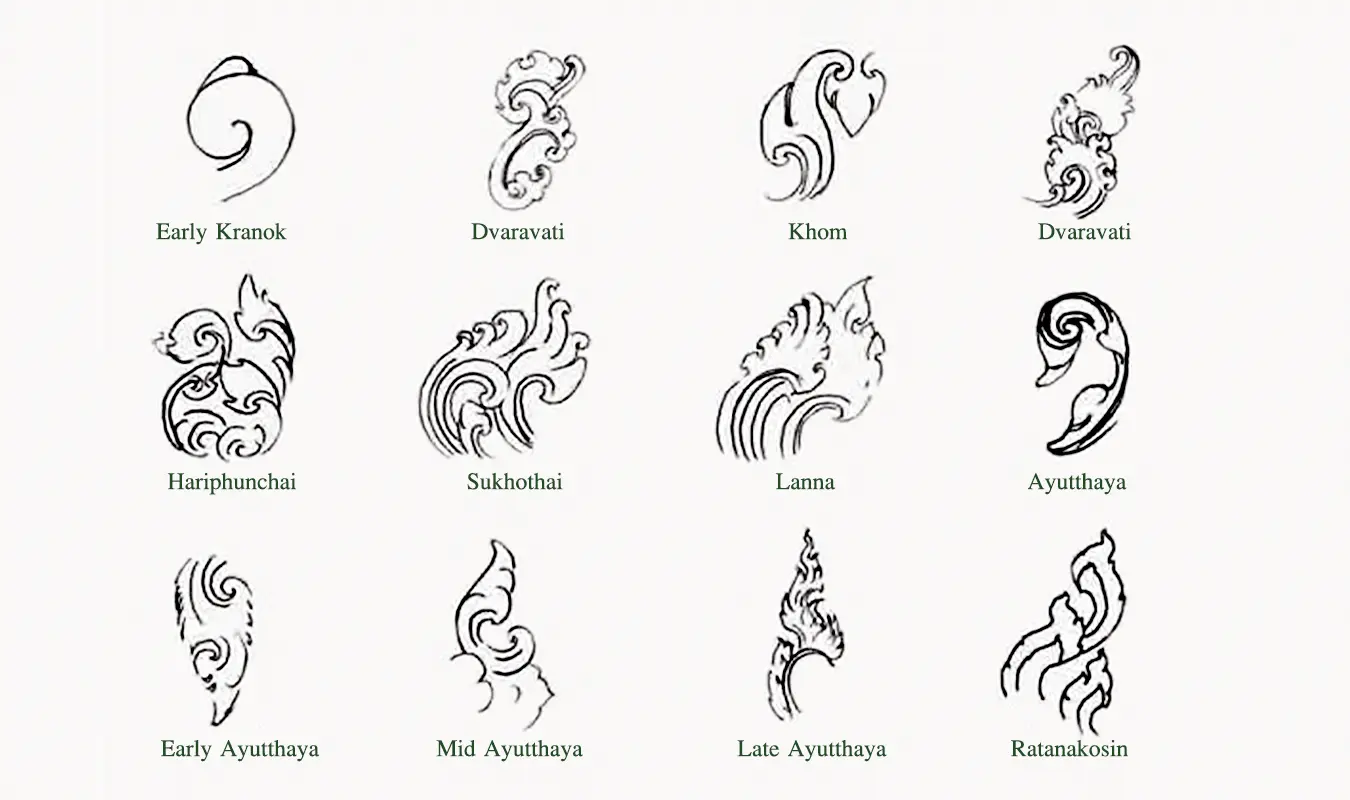
Kranok evolution from each kingdom by Santi Leaksukhum (from Thai junior encyclopedia)
The Four Pillars of Thai Pattern Art
To understand Thai artistic tradition, we can explore four key categories:
1. Kranok Motifs
The Kranok pattern represents the foundation of traditional Thai decorative design. It emerges from natural inspirations—flames, foliage, animals, and plant forms—transformed through Thai imagination and sacred beliefs. The word “Kranok” is believed to originate from two ancient terms: Kor Nok (meaning “a herd”) and Kor Mai (meaning “a clump of plants”), signifying harmony between living beings and the natural world.
Within this foundational group, master motifs evolve into six major styles, each rich in symbolism and structure:
|
Thai Motif |
Inspiration |
Visual Structure |
|
|
Kranok |
Inspired by flame tips and leaves |
Right triangle, flame-like spire |
|
|
Krajang |
Modeled after lotus petals or sugarcane buds |
Isosceles triangle, petal-shaped arch, smooth and symmetrical |
|
|
Prajamyam |
The four-directional guard or four-petal flower |
Tilted square (diamond-like) representing balance and protection |
|
|
Kreuathal |
Reflects entwined climbing vines |
Flowing interwoven lines, organic curves |
|
|
Phumkaobin |
Shaped like alms-rice offerings or budding lotus |
Teardrop or cone-like structure |
|
|
Krab |
Mimics the sheath joints of bamboo or sugarcane |
The separator and connector pattern |
|

The master Thai motifs (from Pinterest)
2. Portrait and Divine Imagery
Design depicts mythological characters, gods, and celestial beings with stylized postures and gestures. These figures often appear in Buddhist narratives and temple murals.

The portrait elements (from Pinterest)
3. Human and Mythical Beings
Drawing from Thai epics like the Ramakien, craftsmen represent giants, monkeys, and hybrid creatures to reflect moral stories and cosmological ideas.

The group of giant image elements (from Pinterest)
4. Mythology Animals and Creatures
Thai art combines and depicts both real animals and mythical ones from the Himmapan forest, such as kinnaree (half-woman, half-bird), garuda (divine eagle), and singha (lion). These creatures symbolize virtues like strength, grace, and guardianship.

Thai mythology animals (from Pinterest)
Each design requires training in brushwork and proportion, demanding both discipline and imagination. Artists learn to balance flowing lines, spacing, and rhythm to achieve visual harmony and sacred elegance.
The Cultural Significance of Thai Patterns
More than an artistic tradition, Thai patterns express philosophical and spiritual values. Symmetrical and rhythmic designs reflect harmony with nature and the cosmos. Lotus flowers represent purity and enlightenment, while vines and flames suggest growth and transcendence.
Traditionally, Thai motifs adorn temples, palaces, and royal items. They also appear in textiles, jewelry, and lacquerware. Yet their purpose extends beyond beauty; each motif carries cultural and moral meaning, often used in rituals or storytelling.

Antique Bencharong (From Prasit Tangjitrapitak)
Bencharong Ceramics: Preserving Beauty and Belief
Bencharong (“five colors”) ceramics offer one of the most refined ways to appreciate Thai patterns. Originating from royal courts, Bencharong combines Thai artistry with Chinese porcelain techniques. Early Bencharong pieces featured large motifs and were painted by Chinese artisans. However, as Thai craftsmen mastered the techniques, they created more intricate, symbolic, and culturally resonant designs.
By the reign of King Rama II (1809–1824), Bencharong reached new heights with the addition of lavish pure gold painting. This “golden age” continued into the reigns of Rama IV and V, when Western influences blended with Thai aesthetics to produce elegant sets, such as the “Chakri pattern” tea sets, adorned with daisies and refined geometry.
Today, artisans continue to paint each Bencharong piece by hand, often adapting traditional patterns into new forms. These porcelain works serve as both decorative art and commemorative items, representing a deep connection to the value of identity and memory.
Miniature Masterpieces: Thai Patterns on Bencharong Urns
One modern yet meaningful adaptation of Thai patterns appears on cremation urns, especially those handcrafted in the Bencharong style. Because the surface of an urn is smaller than that of a wall or textile, artisans must scale down their designs with precision.
Each urn becomes a canvas for timeless symbolism. Golden lotus petals, spiraling vines, or mythical animals reflect both spiritual values and personal legacy. These patterns are not merely ornamental; they speak to the essence of the person remembered.
By preserving traditional motifs in this form, families not only honor their loved ones but also participate in the living heritage of Thai craftsmanship.

Conclusion: Crafting Legacy Through Pattern and Purpose
Thai artistic patterns are a convergence of nature, philosophy, and national spirit. They have endured through centuries of change, adapting to new forms while maintaining their meaning. From temple murals to porcelain urns, these motifs continue to embody beauty, memory, and cultural pride.
At UniqueUrn, we believe that honoring a life means more than remembering a name. It means preserving the stories, symbols, and spirit that made each person unique. By supporting handcrafted Benjarong urns, you help sustain the Thai artistic legacy and celebrate a life lived with dignity, love, and cultural identity.
In every brushstroke lies a meaningful tribute. In every pattern, a memory. In every urn, a story is waiting to be cherished.

“We have learned about the basic inspiration behind Thai patterns in Bencharong. From here, we can also explore the details of each pattern element and the meaning embedded in the article What Does Each Design Mean?”